


Territorial taxation in Paraguay is that famous 0% on foreign income everyone talks about. Except 0% on foreign income does not mean 0% on everything. Here is what is genuinely exempt, what stays taxable in Paraguay, and the trap that costs nomads dearly.
Territorial taxation, what it actually means
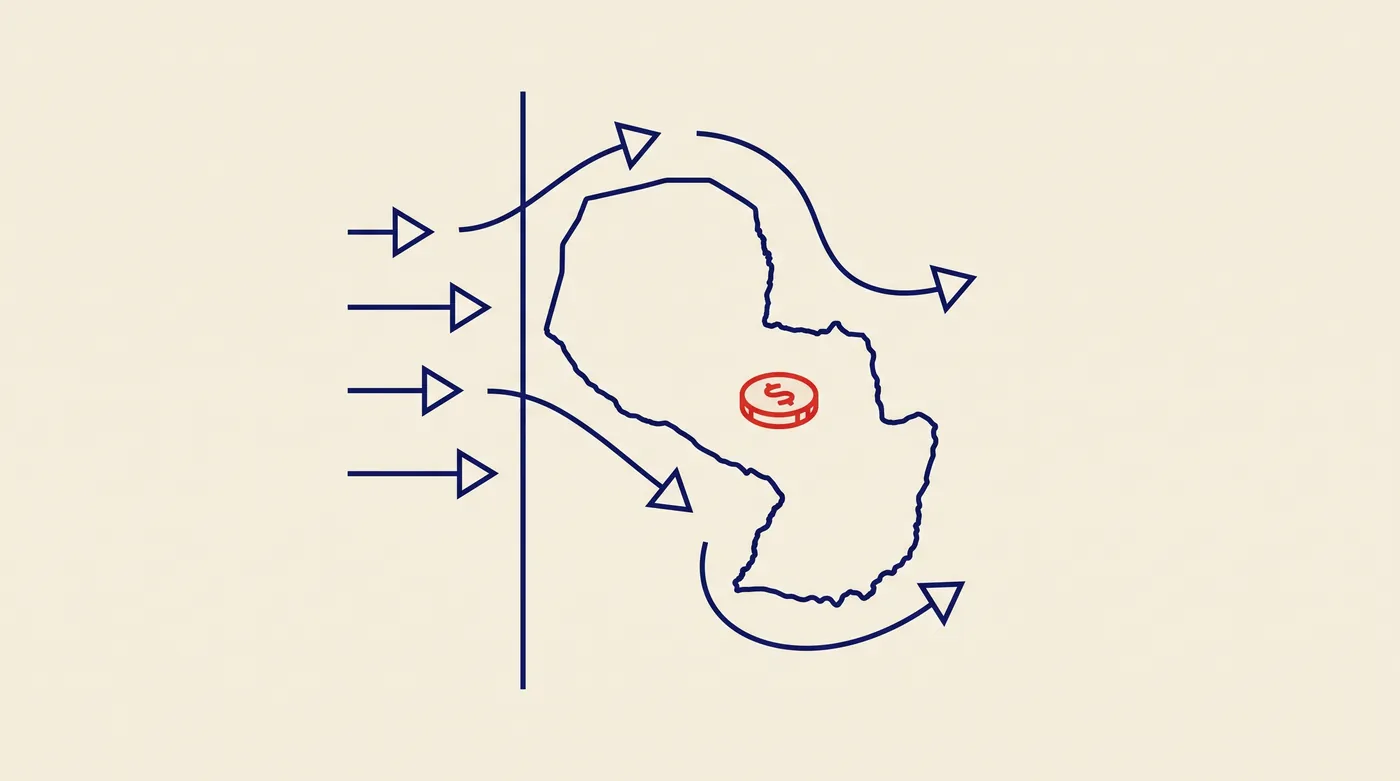
Territorial taxation in Paraguay fits in one sentence: the country taxes what is earned on its soil and leaves alone what is earned elsewhere. Your foreign-source income sits at 0%, while your Paraguayan-source income is taxed locally. That is the whole principle, and it is exactly what draws so many entrepreneurs and nomads here.
Where many countries look at where you live to decide what to tax, Paraguay looks at where the money is earned. The difference sounds subtle, but it changes everything. You still need to know what counts as foreign source and what does not. That is exactly the point most articles skip.
What is genuinely exempt (0%)
In practice, a Paraguayan tax resident pays nothing in Paraguay on the following income, provided it is truly foreign-source:
- Salary paid by a foreign employer, for work tied to another country.
- Dividends from foreign companies (your US LLC, your European holding, and so on).
- Rent from real estate located outside Paraguay.
- Capital gains made through a foreign broker, a US stock exchange for example.
- Online income invoiced to clients outside Paraguay : consulting, e-commerce, marketing, freelance.
The common thread: if the activity that generates the income sits abroad and the client pays from abroad, Paraguay treats that income as foreign. So 0% here. It is not a trick, it is the country's legal regime.
What stays taxable in Paraguay
The other half of the story, the part nobody tells you: everything that is Paraguayan-source is taxed. And there, Paraguay stays very competitive, but it is not 0%. The local regime is often summed up by the 3x10 rule :
- PIT (personal income tax): 10% on your Paraguayan-source income, and only above an annual threshold of local income (in the region of 80 million guaranies, roughly 10,000 to 12,000 euros). Below that, you owe nothing.
- VAT: 10% on consumption.
- Corporate tax (IRE): 10% on the profits of a Paraguayan company. Distributed dividends are taxed separately, at around 8%.
So the following are taxable in Paraguay, for example: the rent of an apartment you own in Asuncion, a service invoiced to a Paraguayan client, or the profits of a business you run locally. Worth noting too: the capital gain on reselling Paraguayan real estate is lighter with residency (around 2.4 to 2.5%) than without (about 4.5%). To handle your taxpayer number and your filings, see our page Accounting and RUC.
The trap nobody explains: working "from" Paraguay
Honestly, this is where it gets tricky for nomads. "0% on foreign income" does not mean "0% on all my remote work". The real question is not your nationality or the currency, it is where the activity is actually carried out.
If you run your business from Paraguay (decision-making centre, day-to-day management, regular physical presence), a tax authority may consider part of that income to be Paraguayan-source, hence taxable here at 10%. That is no reason to panic: 10% stays low. But promising a full 0% to someone who lives and works full-time from Asuncion is selling a dream. We would rather tell you straight.
0% in Paraguay does not mean 0% everywhere
Paraguay can exempt you, but that alone does not cut the tie with your country of origin. That country sets its own exit rules, and they are often stricter than people think.
- No tax treaty between France and Paraguay. Unlike Spain or Italy, there is no double-taxation agreement between France and Paraguay. So in theory you can be considered a tax resident of both at once. You have to actively cut your ties with France: home, economic interests, presence.
- Being a tax resident of nowhere is a bad idea. The goal is not to vanish off the radar, it is to be clearly a Paraguayan tax resident, with a RUC and, if needed, the constancia de residencia fiscal that proves it.
- Good to know: Paraguay does not automatically exchange banking data (it is not part of the CRS system), and it has neither wealth tax nor inheritance tax in direct line. That is part of the comfort, but it does not replace a clean exit from your former tax residency.
This article is educational, not legal advice. Depending on your nationality and your country of departure, the exit rules change. Before you move, have your situation validated by a tax adviser in your country of origin.
What you actually need to set up
Territorial taxation does not switch on by itself just because you set foot here. It is built with a real status. In broad terms: first the tax residency (legal residency, cedula, then RUC), then the filings. Even if all your income is foreign and you owe nothing, the filing stays mandatory to keep your tax-resident status in good standing. One accountant who lets a filing slip, and the whole file is delayed.
Depending on your profile, theInvestor Pass can also open a faster route to residency. We look at what is realistic for you, and what is not.
We set up your tax base properly
From residency to RUC, in French and with no hidden fees, our team on the ground puts your entire legal and tax base in Paraguay in order. We explain what is exempt, what is not, and how to avoid the traps that cost you dearly. The simplest thing is to talk it over: take a look at our pricing or book a free first call to review your project.